Thoughts · on Nijimi
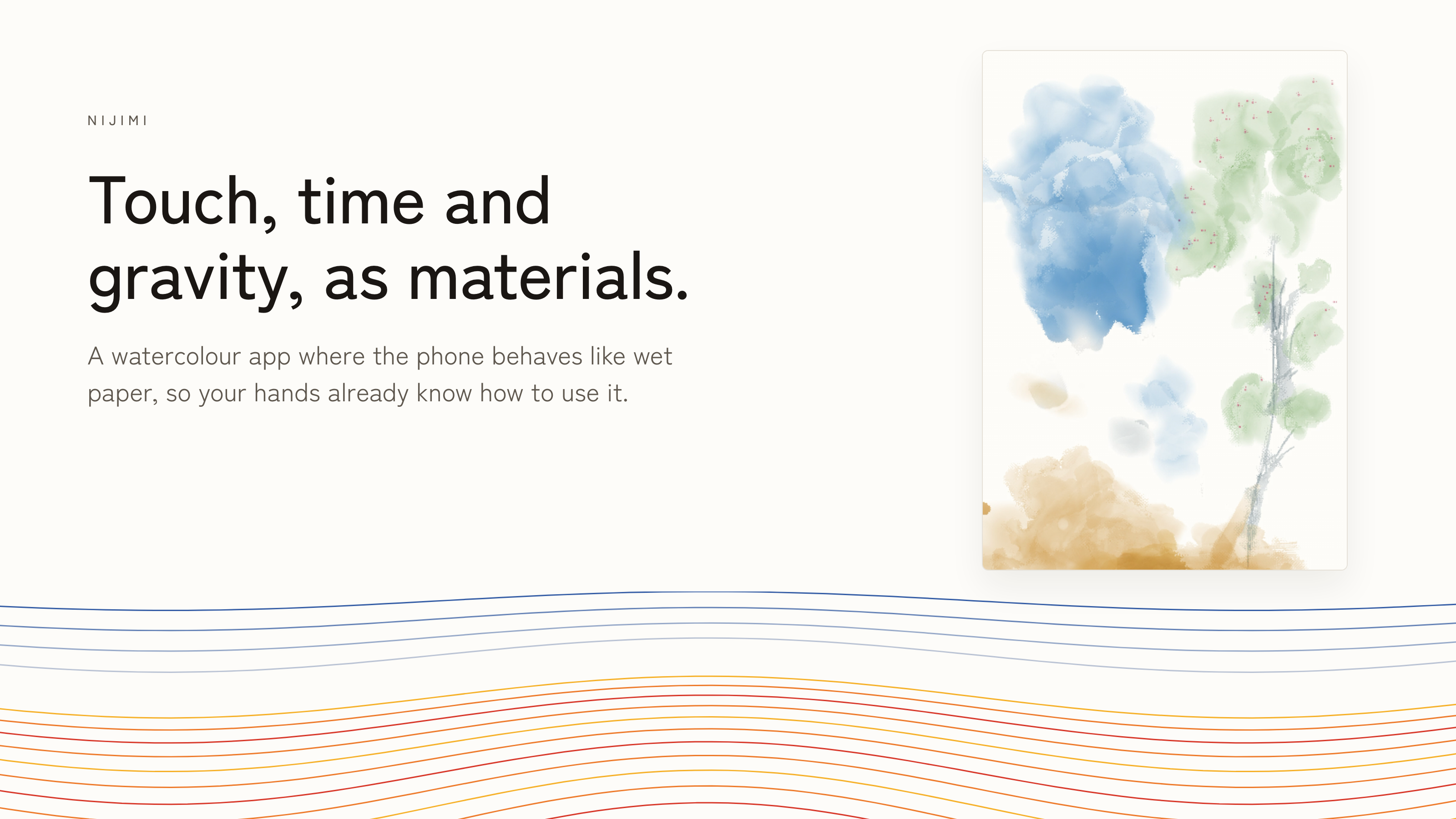
Touch, time and gravity, as materials
Painting apps mostly turn what hands already know into settings. Nijimi tries it the other way round.
Hand someone a brush, a jar of water and a sheet of paper, and they do not ask how it works. They press harder for a wider mark. They wait to see what the water does. If a wash is running the wrong way, they tip the board. Nobody taught them that. It is what hands already know about the physical world.
Painting apps mostly set that knowledge aside and turn it into settings: a size slider, an opacity slider, a blend mode, a smudge tool, an undo button. Each one is a translation. Before you can paint, you learn the software’s version of something your body already understood.
I wanted to try it the other way round. Nijimi is a watercolour app for iPhone, and the idea behind it is simple: if the sheet behaves like wet paper, people already know how to use it. The name is the Japanese word for the way ink bleeds into wet paper.
Behaviour instead of settings
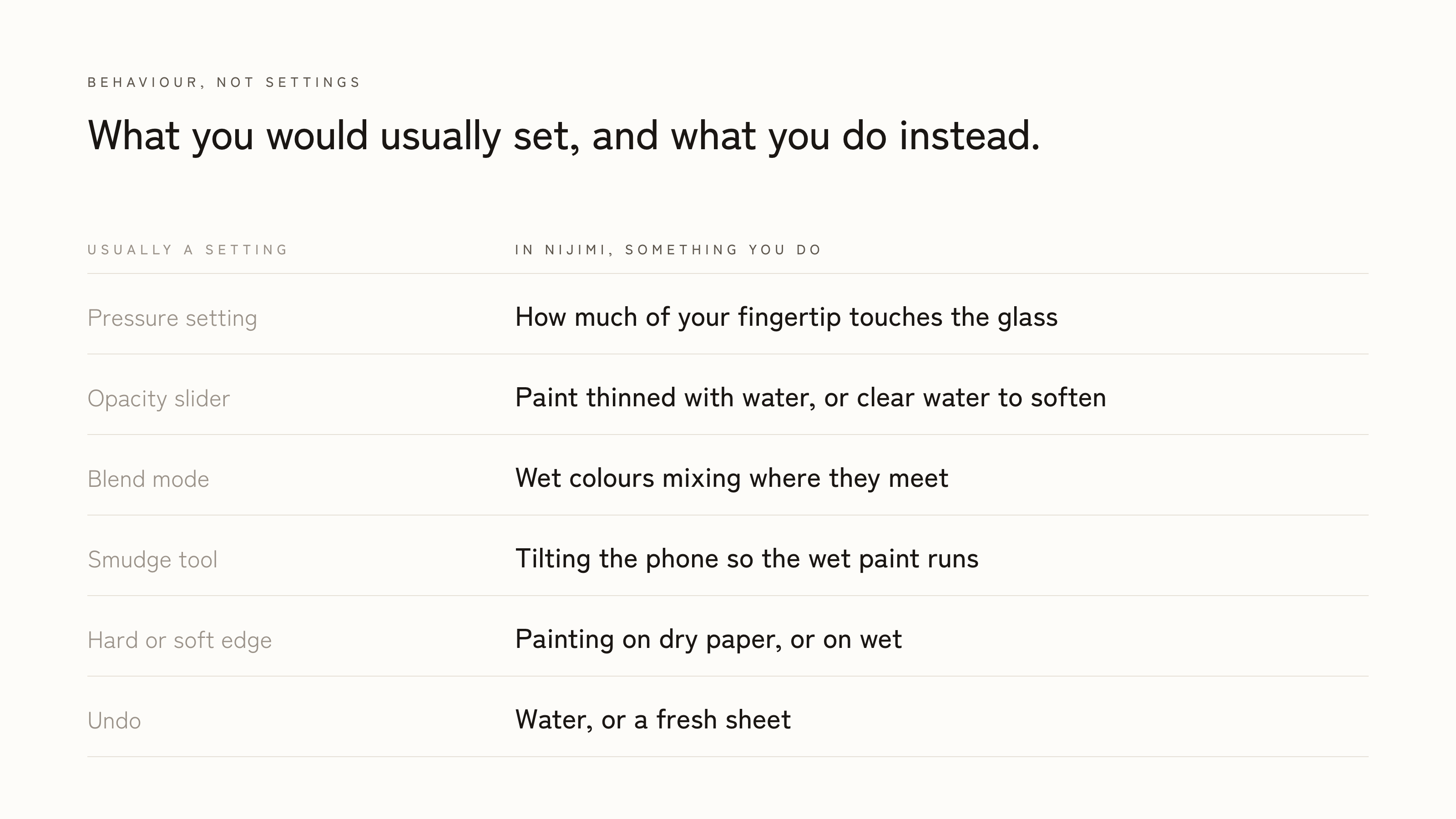
A phone is full of senses. The screen knows how much of your finger is touching it. The accelerometer knows which way is down. There is a clock. Most apps spend those on getting you through menus. In Nijimi all three point at one thing, a sheet of wet paper, and that turns them into materials: touch, gravity and time are what you paint with, in the same way a painter works with water and a tilted board.
The only instructions the app gives fit on its start screen: drag your finger across the sheet, and tilt the phone to move the water. Everything else you find out by painting.
Touch
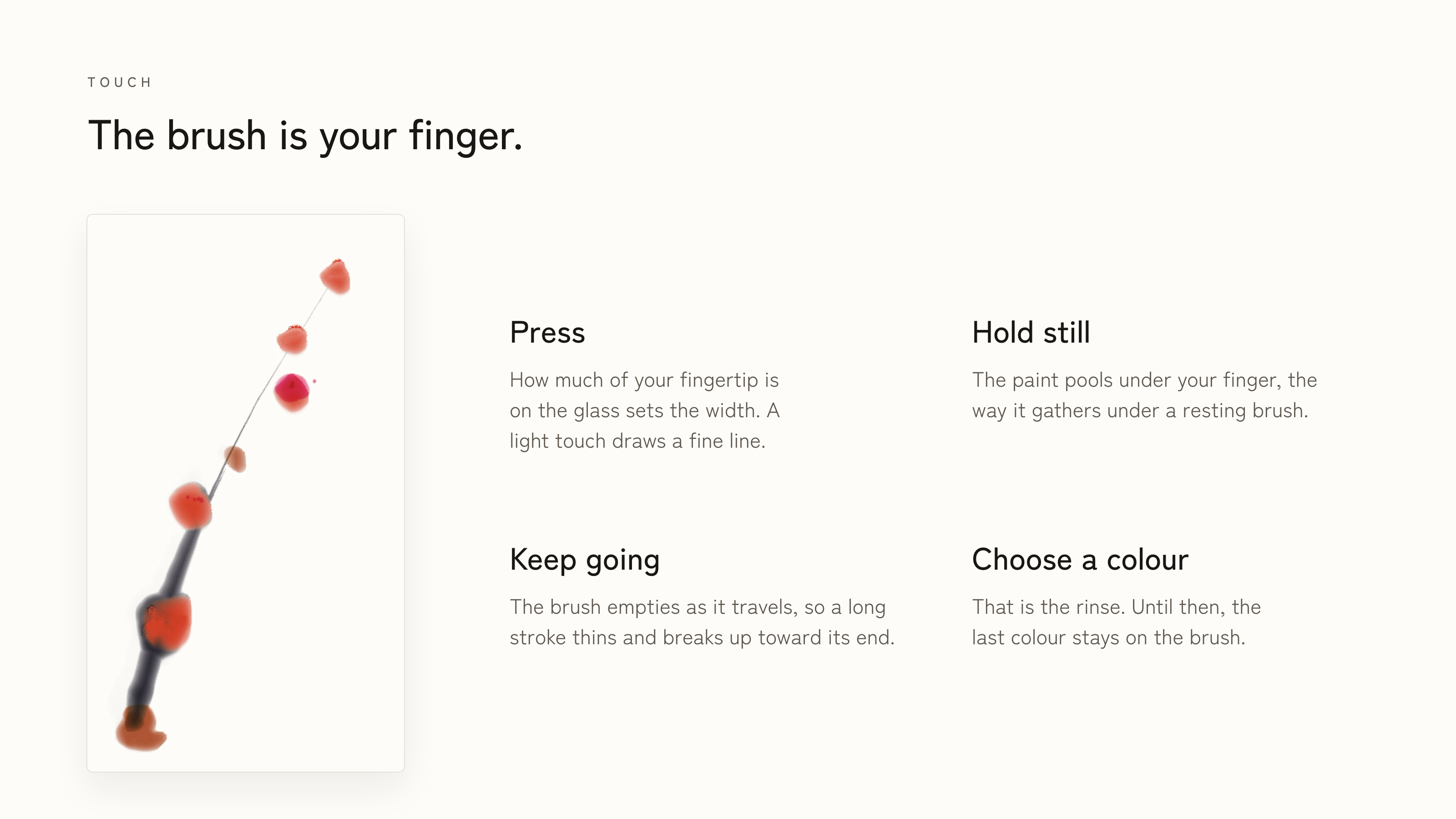
The width of a mark comes from your finger, not from a menu. The phone reports how much of your fingertip is pressed against the glass, so a light touch draws a fine line and a flatter one draws a broad one. That reading is coarse, and every hand is different, so the app learns the range your own finger makes and maps it onto the whole brush. When the sensor is unsure, the speed of the stroke fills in.
The brush behaves like a brush, too. It lands on its tip and widens into the stroke. Hold still and the paint pools under your finger. Keep going and the brush empties, so a long stroke thins and breaks up toward its end. And a colour stays on the brush until you choose another, which is the app’s version of rinsing it in the jar.
Water and pigment
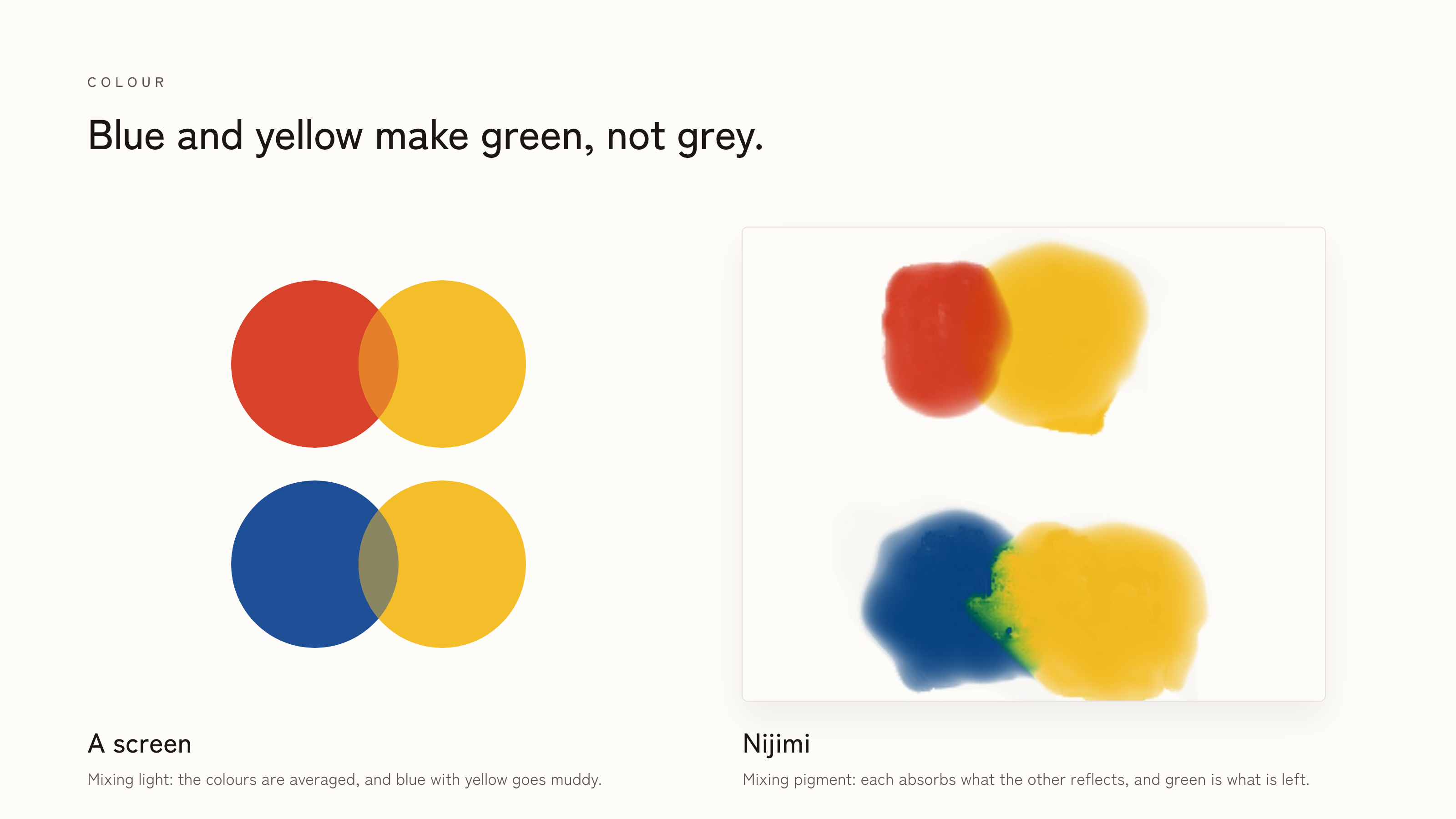
Where two wet colours meet, they mix the way paint does, not the way light does. On a screen, blue and yellow average out to a muddy grey. As pigments, each absorbs what the other reflects, and what is left is green. Nijimi works each mix out ahead of time from measured pigment data, so the colour you get is the colour the paper would give you.
The paper matters as much as the paint.
On dry paper a stroke keeps a crisp edge. On wet paper the same stroke blooms softly outward. Beside the colours there is a slot of clear water, for softening an edge or wetting the paper before you paint into it. A painter decides how a mark will look by deciding how wet the paper is, and that works here the same way.
Gravity
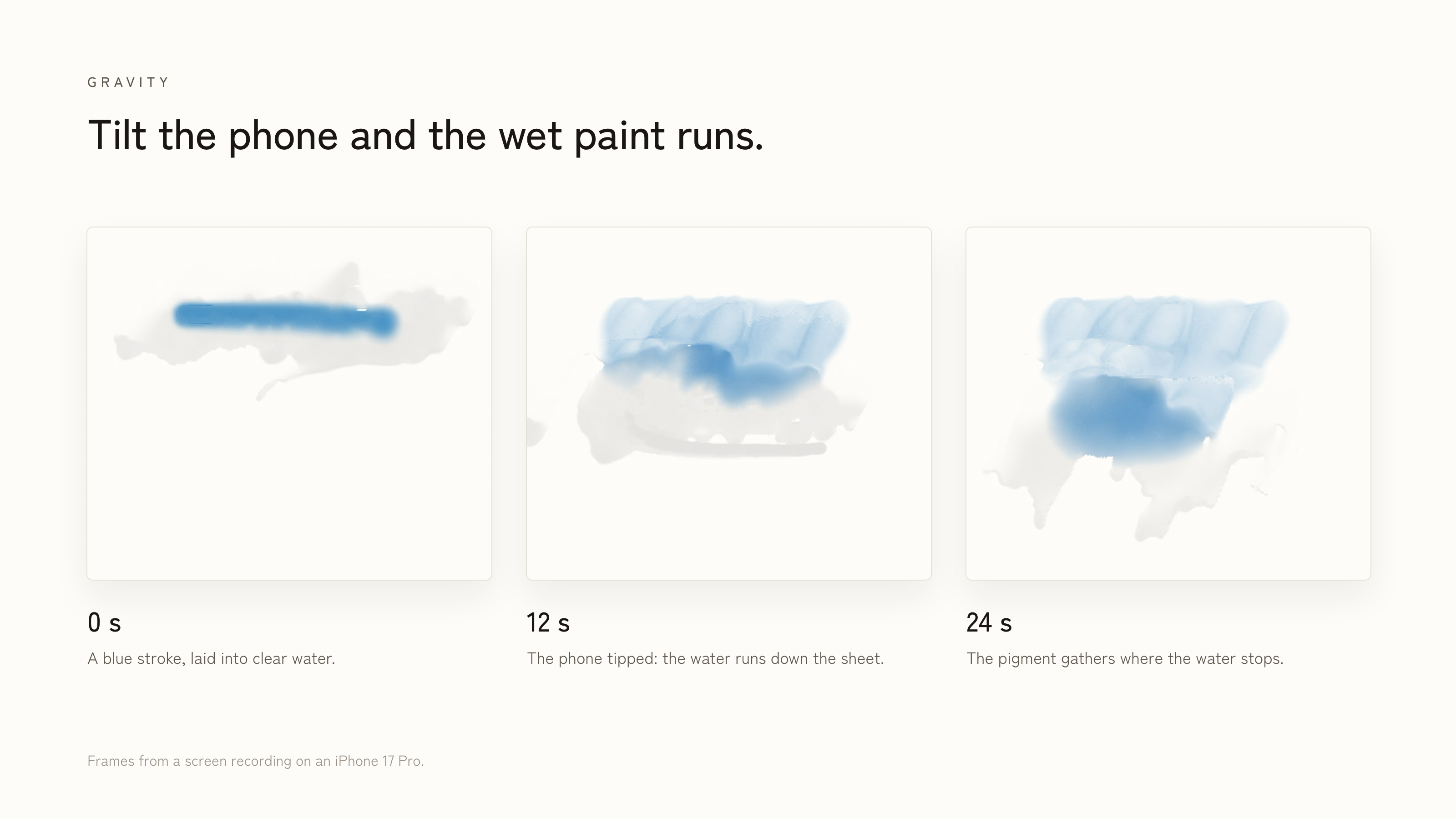
Lean the phone and the wet paint runs downhill, carrying pigment with it and gathering where it stops. Paint that has dried stays where it is. It is not an effect you switch on. It is the same simulation answering the accelerometer, the way a painter tips the board to push a wash where they want it.
It needs no explanation, because everyone already knows what water does on a slope.
Time
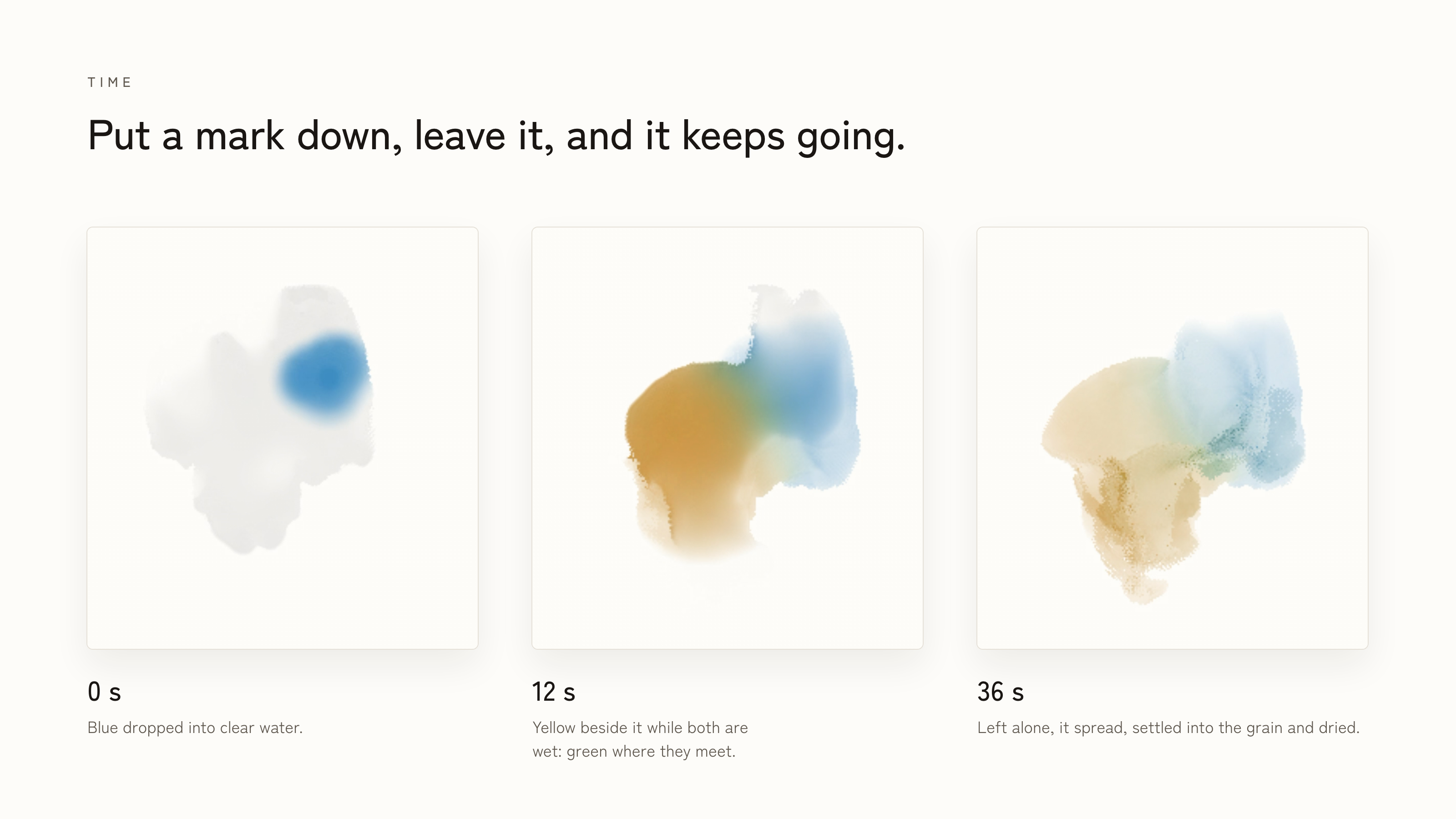
Put a mark down and leave it, and it keeps going. It spreads while the paper is wet, settles into the grain as it dries, and stops when there is no water left to carry it. A wash stays wet for about fifteen seconds and is dry in about thirty.
That makes waiting a way of painting. Put yellow beside blue while both are wet and they run together into green. Wait until the blue has dried, and the same yellow glazes over it instead, so you see both. The same two strokes make two different paintings, depending only on when you make the second one. I cannot think of anything else on my phone that asks me to wait.
What it changes
When a material behaves consistently, a mark you did not expect is not an error. It is information: this is what wet paper does when you do that. So you try it again, on purpose. That is how anyone learns a real medium, and it only works if the medium is consistent enough to learn from.
It is also why there is no undo. A wet stroke mixes into what is already on the sheet and keeps moving after you lift your finger, so there is nothing clean to step back to. But even if there were, undo would tell you the unexpected mark was a mistake, and people are not wrong when they explore. Watercolour has always had two answers to a mark you do not like: water, or a fresh sheet. Those are Nijimi’s answers too.
Tuned by painting
How far water travels, how fast it dries, how wide a finger’s mark lands: those are numbers, and no amount of reasoning finds the right ones. So before judging any of it, I wrote the medium down from the painter’s side, as tests the app had to pass. You paint with water first. Timing is the medium. You cannot lighten, because the white is the paper. The same brush gives a hard edge on dry paper and a soft one on wet. Gravity is a tool.
Then the numbers were found by painting on the phone, next to real watercolours, until the sheet stopped feeling like software.
What it is not
It is not a tool with five hundred brushes, and not a filter that makes a photo look like watercolour. It has no account, no server and no analytics. Your paintings stay on your phone unless you share them.
The two before this one
This is the third app I have written up here. The first was Neshi, a breathing app, and the piece was about the moment an AI correctly turned 190 mindful minutes into 3 mindful hours and made a month of practice look like nothing. Production got cheap; deciding what good means did not. Read it here.
The second was Furlong, a running coach that plans your week from what your body actually did. That one argued that a beautiful shell is only half the job, and the engine underneath is the other half. Read it here.
Nijimi is the same argument from the other end.
Neshi was about judgment, Furlong about the engine, and this one is about what happens when the engine is a material and the judgment is to leave it alone.
What I keep coming back to is how little of this is new. People have always known how to paint with water, gravity and time. The phone already had the senses to notice. Most of the work was getting out of the way.
And this is what became of it
Nijimi is a watercolour app for iPhone: touch, gravity and time, as the only tools.